
Shikoku - 1995

We were engaged by the Japanese tourist bureau to make a documentary about the Japanese island of Shikoku.
That was the official reason stamped on the paperwork, anyway. In practice, it felt less like an assignment and more like being dropped into a quiet corner of the world that hadn’t yet decided whether it wanted to be seen.
It was 1995. Japan was still recovering from the burst economic bubble, but Shikoku seemed untouched by the frantic optimism that had preceded it or the anxiety that followed. The island moved at a contrasting tempo—one shaped by mountains, fishing towns, rice paddies, as well as major cities largely untouched by the west. This was an island ringed by a long slow arc of the 88-temple pilgrimage that had drawn monks and wanderers for over a thousand years.
There were three of us, technically: myself, Garret Gluck, and the woman assigned to us as interpreter and fixer, Keiko Nakamura. And if the job was to document Shikoku, the deeper truth was that the island was gently educating me.
1. Garrett
Garrett was the first surprise. Half-Japanese, half-American, and chain-smoking his way through life as if nicotine were the thread keeping the universe stitched together. He was young—much younger than me—and brilliant in the casually feral way of someone who never asked for permission. His nerves were alive. His lighter was always in motion. His humor was sharp enough to cut, and he drove like a man who had memorized every curve in the road but still resented the need to turn the wheel.
He knew Japan better than I did, had lived there, and spoke the language very well, and navigated the island’s backroads with a confidence that was almost offensive. I didn’t like him immediately. I liked him and was puzzled by him in equal parts—we travelled one bento box, one cigarette break, one dinner roadside stop at a time.
We became friends the way professional men do when trapped in a moving car for ten days: accidentally, against our better judgment, and without ever announcing it.
2. Keiko
Keiko was our assigned liaison from the Japanese tourism office. Mid-30s, polite to the point of apology, practical and gentle. She carried herself with a kind of formal grace, the kind that made you straighten your posture without being told. Her English was limited, my Japanese nonexistent, so our early conversations consisted of nods, hand gestures, and a shared commitment to not causing unnecessary embarrassment. Garrett did the translating.
She never flirted, never complained, never lost composure. Always very professional. And yet—she had removed her wedding ring.
I noticed it on the third day, when she was pointing out a roadside shrine on the way to Tokushima. No tan line. No indentation. Just an empty space where one expects a symbol to live.
Did it mean anything? I didn’t ask. Maybe in Japan it meant nothing. Maybe a married Japanese woman, in the company of an American was a lightning rod. That's what I assumed anyway. (The cranky looks of the occasional Japanese men in sushi bars and coffee shops seemed to validate that.She was tall and willowy, and had a presence.)
Maybe she took it off because of us, because the job required a certain neutrality, because married women in Japan were expected to be invisible in ways I didn’t fully understand. Or maybe the marriage itself had already gone quiet. I still don’t know. The not-knowing is part of the memory now, and part of the forever mystery.
3. Tokushima – The First Gate
We entered Shikoku through Tokushima, a quiet city of rivers, mountains, and distant drums practicing for the Awa Odori dance festival. The Awa Odori Kaikan was still new then—opened in 1992—clean glass, fresh signage, not yet worn smooth by tourists. We filmed rehearsal dancers, young girls learning to keep their shoulders still while their feet moved like quick water. Their music was built on two notes, three beats, and centuries of stubborn joy.
Outside the city, the hills held the ghost of the Genpei War—battlefields from the 12th century where samurai once died over the future of the empire. You could stand on the bluffs at Yashima and look down at Takamatsu Bay, calm as prayer beads, and imagine no violence had ever happened here. Japan is good at burying blood beneath beauty.
Garret stood by silently, the ocean wind blowing ash from the end of his cigarette.
4. Takamatsu – The Pause Between Eras
We rode the train into Takamatsu, where the Seto-Ōhashi Bridge had only recently connected Shikoku to the mainland. Before 1988, you had to sail to this island; now you could glide in on rails. Even so, it didn’t feel connected. Shikoku wasn’t cut off—it was simply uninterested in joining the race.
We walked Ritsurin Garden, where pine trees had been shaped for three centuries by men who understood patience as a form of art. Keiko spoke softly about “shizen no katachi”—“the shape of nature,” though half of what she said was lost to vocabulary gaps I pretended not to have.
In Marugame, we filmed inside the Genichiro-Inokuma Museum of Contemporary Art—a perfectly white modernist box full of color and abstraction. I remember the silence most of all. It was the only museum I’ve ever been in where footsteps felt like vandalism.
5. Kotohira – The Ascent
Nothing prepared me for Kotohira-gū, the great guardian shrine of sailors, perched eight hundred uneven stone steps above the town. We climbed at sunrise, passing merchants, monks, schoolchildren, and one elderly woman wearing the white jacket of a pilgrim. She bowed to Keiko. She nodded to me. She did not acknowledge Garret, who was filming her with the quiet reverence he reserved for subjects who didn’t know they mattered.
Halfway up, we stopped for mikan oranges and tea. Near the top, the world opened—roofs, fields, clouds, the whole Sanuki plain spread out like a map painted in soft greens. I understood then that the pilgrimage wasn’t about religion. It was about perspective. You climbed until the small things stayed small.
6. Matsuyama – The Poet’s Quiet
In Matsuyama, we entered the world of Masaoka Shiki, the haiku reformer who dragged Japanese poetry into the modern age by refusing to prettify anything. The Shiki Memorial Museum—already more than a decade old in 1995—was humble, book-lined, and full of air that smelled faintly of cedar and ink.
A curator tried her best to explain Shiki in English, though half of it dissolved into apologetic laughter. She showed us a handwritten poem and said, “Shiki liked truth. Not illusion.”
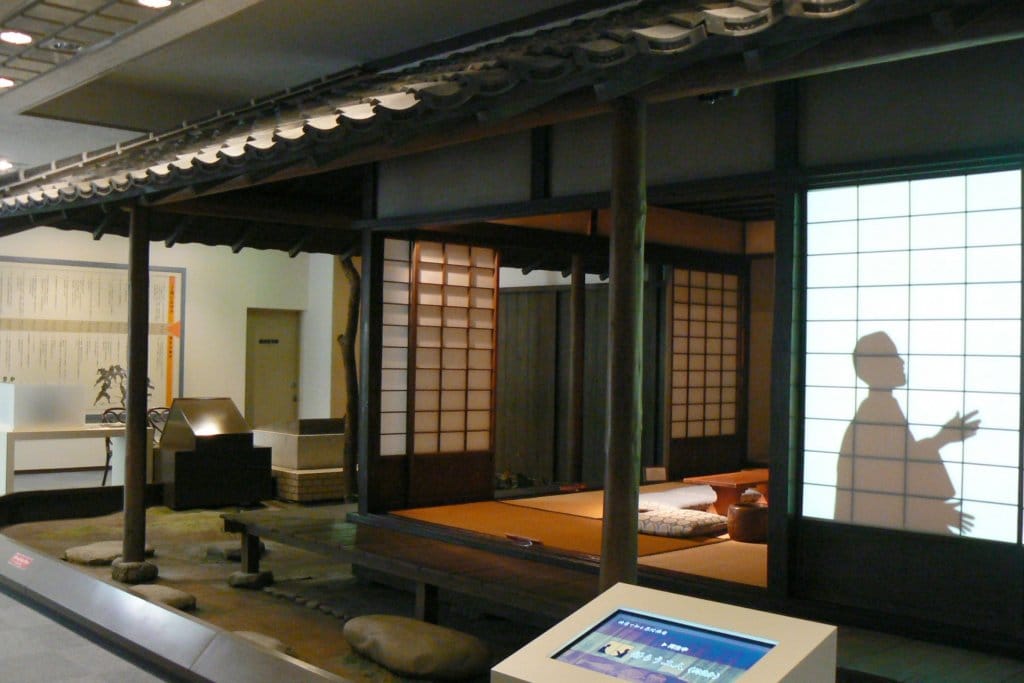
That night Garrett and I bathed at Dōgo Onsen, where the steam rose through ancient wooden slats and tourists soaked alongside locals in total silence.
7. Kochi – Salt, Wind, and Ryōma
We reached Kochi last, where the Pacific crashed hard against the rocks and history grew teeth. This was the land of Sakamoto Ryōma, the samurai-turned-revolutionary who helped topple the shogunate. His bronze statue looked out over the sea, full of that idealistic fire Japan has almost successfully forgotten.
The Ryōma Memorial Museum sat on a windy cliff, documents and swords inside, salt wind and gulls outside. Garret filmed everything. I filmed Garret. Keiko stood still, hands folded, hair pushed by the wind but never out of place.
That night, we ate katsuo no tataki—bonito seared in straw flame—while Garret smoked, and the cook laughed at our attempts to repeat the Kochi dialect. Between the smoke and the sake and the ocean, everything felt slightly unreal.
8. Leaving
When we left the island, it felt wrong to do so.
Not dramatically wrong—just quietly incorrect, like closing a book before the sentence ends.
Shikoku didn’t try to impress us. It didn’t perform. It barely acknowledged us. And maybe that’s why it has stayed in my mind longer than any neon megacity or perfectly choreographed tea ceremony. It was real. Unbothered. Whole.
Garrett's spirit is somewhere out there now—in between two places I bet, probably still smoking, probably still ready to make wry comments. We've lost him, it seems. Keiko is wherever Japanese politeness and unspoken thoughts eventually go—her life resuming in the spaces we never saw.
And me? I still think about the ring she didn’t wear. And the places we didn’t film. And the way the island never once asked us to understand it. I loved that experience.
Just to witness it was a privilege.
Which, in the end, was the real assignment all along.